

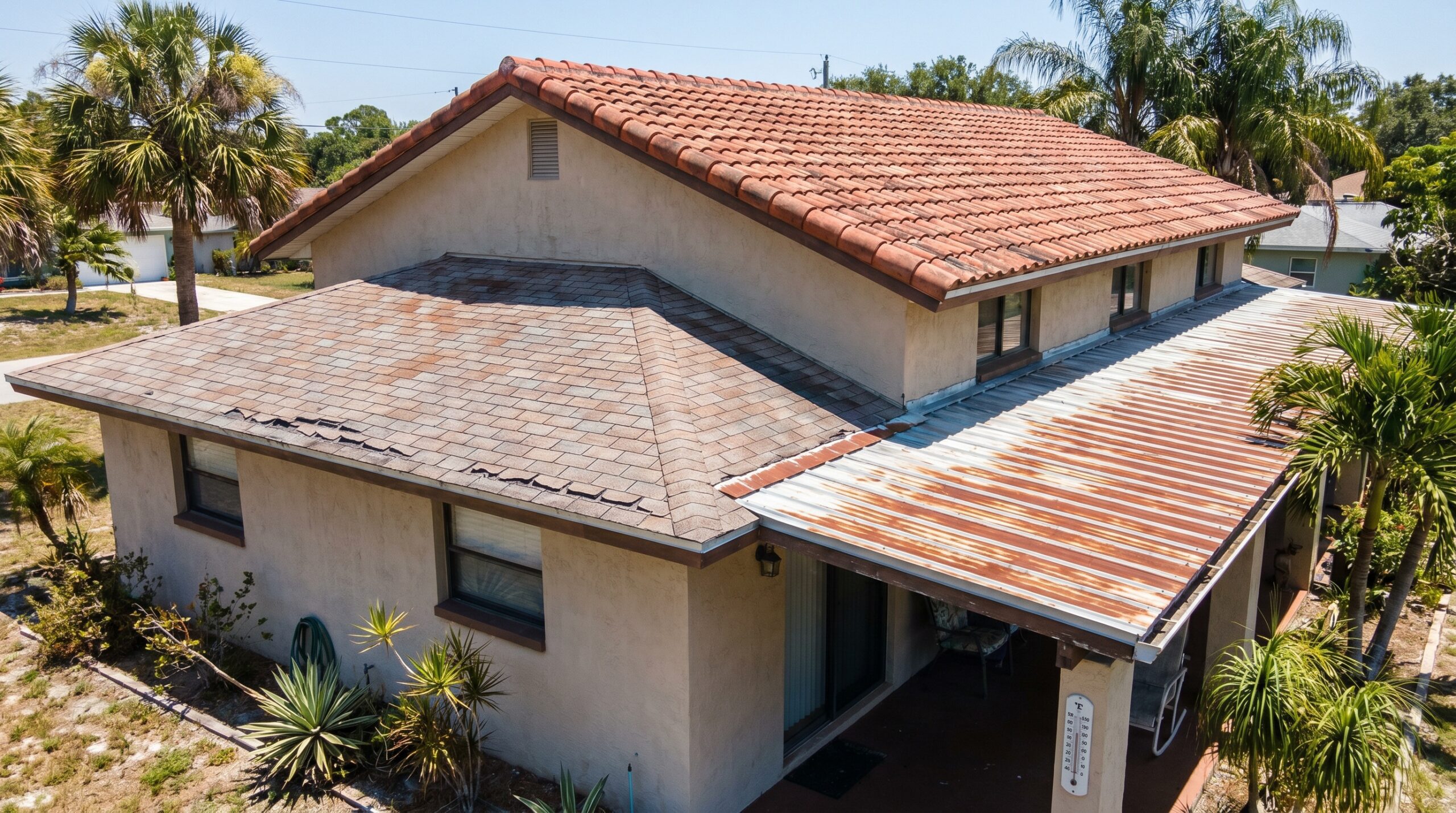
How Long Does a Roof Last in South Florida? Lifespan by Material and Climate
May 6,2026
South Florida’s unique climate creates a challenging environment for roofing materials. While a roof in a temperate climate might last 25-30 years, South Florida roofs typically last 15-25 years due to intense UV radiation, year-round humidity, salt air exposure, and frequent storms. The specific material you choose makes the biggest difference in longevity, and understanding the best roof types in Florida can help guide your decision.
Understanding realistic roof lifespans in South Florida helps you plan for maintenance and replacement costs. Your roof’s actual lifespan depends on material type, installation quality, maintenance frequency, and exposure to coastal conditions. Let’s explore what you can realistically expect from different roofing materials in Martin, St. Lucie, and Palm Beach counties.
Quick Answer: Architectural shingles last 15-22 years in South Florida, metal roofs 30-60 years, and clay tiles 75-100+ years. Coastal properties typically see 3-7 years shorter lifespans due to salt air exposure.
Average Roof Life Expectancy in South Florida
South Florida roofs face unique challenges that significantly reduce manufacturer-rated lifespans. The combination of intense UV radiation, sustained humidity averaging 73-78% year-round, and tropical storm exposure creates conditions that accelerate material degradation.
Manufacturer warranties are calculated under ASTM lab conditions that don’t account for South Florida’s harsh environment, so it’s important to understand what’s covered in roofing warranties. A 30-year architectural shingle warranty translates to about 15-22 years of real-world performance in South Florida. Insurance carriers typically treat shingle roofs as “end of useful life” at 15-18 years regardless of visible condition.
The key difference between inland and coastal properties is salt air exposure. Properties within 3 miles of the ocean—common throughout Martin, St. Lucie, and Palm Beach counties—experience accelerated corrosion and material breakdown, reducing lifespans by an additional 3-7 years across all materials except clay tile, which remains chemically inert to salt.
| Material | Inland South Florida Lifespan | Coastal South Florida Lifespan | Wind Resistance |
|---|---|---|---|
| Architectural Shingles | 15-22 years | 12-18 years | Up to 110 mph |
| Standing Seam Metal | 40-60 years | 30-50 years | 130+ mph |
| Clay Tile | 75-100+ years | 75-100+ years | 150+ mph |
| Concrete Tile | 50+ years | 40-50 years | 150+ mph |
Roof Lifespan in South Florida by Material
Asphalt Shingle Roof Lifespan in South Florida
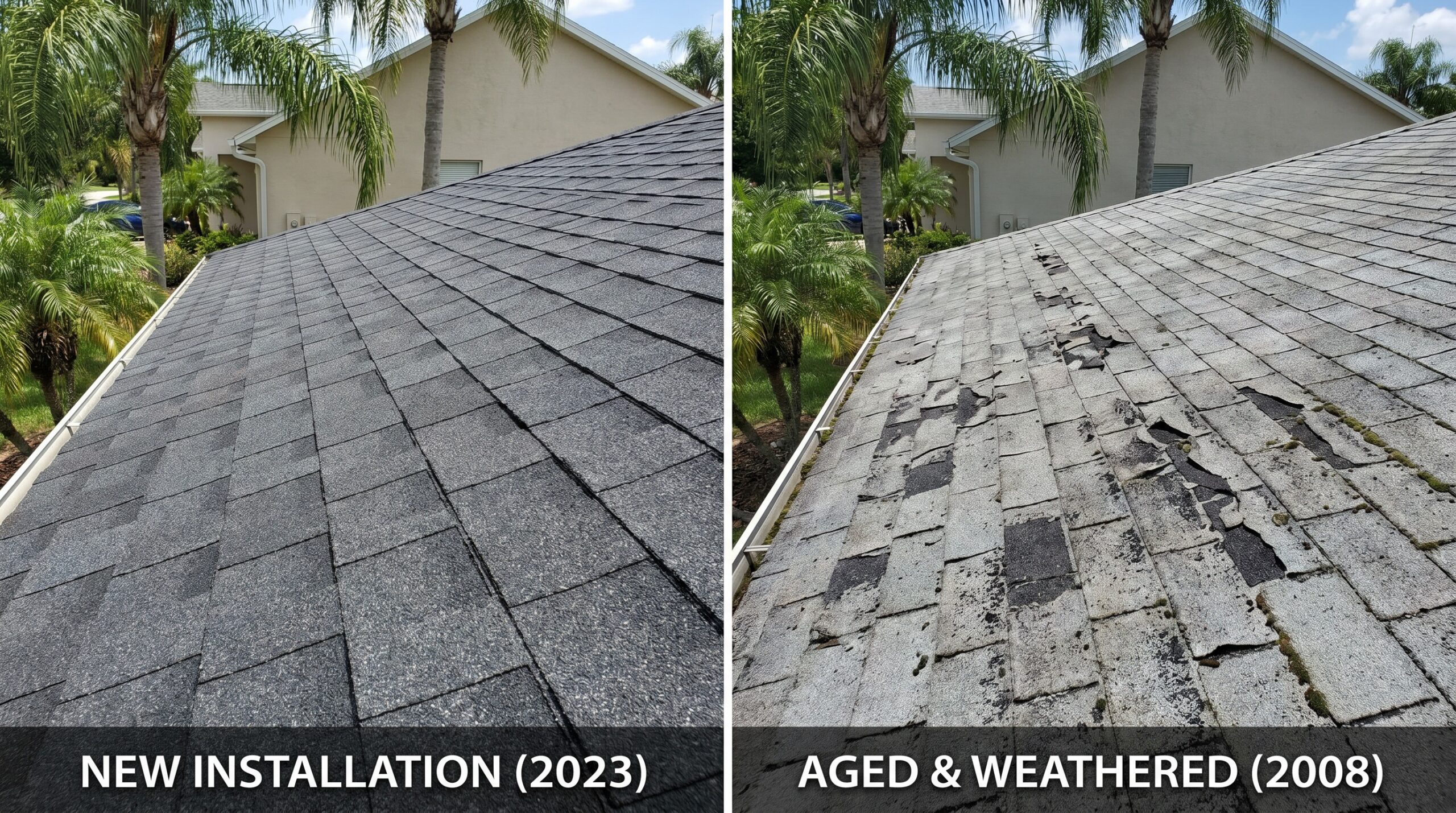
Standard architectural shingles perform for 15-22 years in inland South Florida and 12-18 years in coastal areas. The asphalt mat softens under sustained 90°F-plus summer roof temperatures, while UV exposure causes granule loss and sealant strip degradation.
Three-tab shingles, rarely installed since 2026, last only 10-14 years in South Florida. They cannot meet current Florida Building Code wind-rating standards and are effectively obsolete for new construction. If your home still has 3-tab shingles, replacement is likely overdue.
Impact-rated architectural shingles offer better performance, lasting 20-28 years inland and 17-23 years coastal. The polymer reinforcement and denser asphalt mat resist UV degradation longer, though they cost 25-35% more than standard architectural shingles.
Metal Roof Lifespan in South Florida
Metal roofing provides excellent longevity in South Florida’s climate. Standing seam systems with concealed fasteners last 40-60 years inland and 30-50 years in coastal areas. The concealed attachment eliminates the primary failure point of exposed fasteners.
Exposed fastener metal roofs last 30-45 years inland but only 25-35 years coastal. The limiting factor is the exposed screws and rubber washers, which degrade under South Florida’s UV environment and create leak points over time.
For coastal properties throughout Martin, St. Lucie, and Palm Beach counties, aluminum panels resist salt air corrosion better than galvanized steel. Kynar 500 PVDF finish significantly outperforms standard polyester finishes in South Florida’s UV environment and should be specified for maximum durability.
Pro Tip: Standing seam metal roofing with aluminum panels and Kynar 500 coating performs near inland lifespans even in coastal salt air environments.
Tile Roof Lifespan in South Florida
Clay tile represents South Florida’s longevity champion, with realistic performance of 75-100+ years. Original 1920s and 1930s clay tile roofs in areas like Coral Gables and Old Naples remain in service today. Clay’s natural mineral composition resists UV degradation and maintains structural integrity through decades of heat cycling.
Concrete tile lasts 50+ years on the tile itself, but the underlayment typically requires replacement every 25-30 years. This creates the common “lift and relay” practice where tiles are removed, underlayment replaced, and original tiles reinstalled.
The critical factor for both tile types is underlayment quality. Self-adhering peel-and-stick underlayment adds 15-20 years to the system’s viable lifespan compared to standard felt underlayment.
South Florida Climate Factors That Shorten Roof Lifespan
UV intensity in South Florida runs 30-50% above continental US averages year-round. South-facing roof planes receive the worst exposure and typically wear 3-7 years faster than north-facing planes on the same roof. This UV radiation degrades asphalt mats in shingles, fades concrete tile color coats, and wears finishes on metal panels.
Sustained humidity keeps roof surfaces wet longer after rain events compared to drier climates. This slower drying increases algae and lichen growth, with black streaking on shingle roofs being the visible symptom. The cumulative effect accelerates underlayment degradation across all materials.
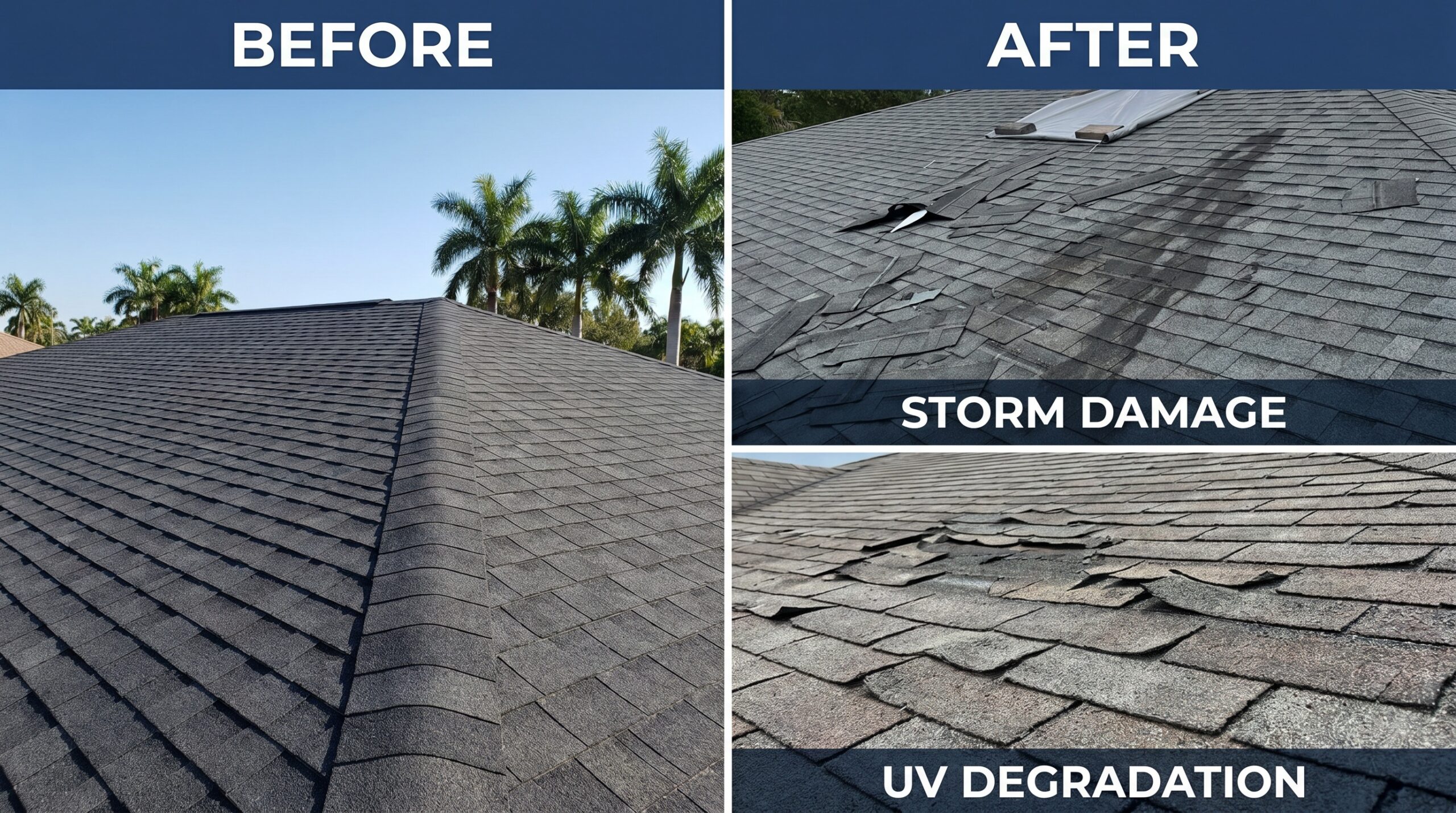
Tropical storm events stress every roof regardless of direct impact. Even a Category 1 brush typically subtracts 2-4 years from a shingle roof’s remaining service life by stressing sealant strips and loosening fasteners. Direct Category 3+ impacts often trigger full replacement due to widespread damage.
Important: Annual inspections become critical in South Florida’s climate, and understanding the average roof inspection cost in Florida helps you budget accordingly. Most carriers now offer 3-5% premium reductions for annual roof inspections by Florida-licensed inspectors.
Signs Your South Florida Roof Needs Replacement
The honest signal for roof replacement occurs when three factors converge: the roof exceeds 12-15 years for shingles (or past underlayment life for tile and metal), insurance requests four-point inspections, and visible condition shows more than three minor issues.
For shingle roofs specifically, granule loss in gutters indicates the protective coating is failing. Missing or curled shingles after storms suggest the material has become brittle from heat and UV exposure. Interior water stains or recurring leaks despite repairs indicate underlying structural issues.
Age-based replacement timing varies by material. Shingle roofs past 15 years should receive annual professional inspections. Tile roofs need underlayment assessment at 25-30 years. Metal roofs require fastener and coating evaluation every 10-15 years, especially in coastal areas throughout Martin, St. Lucie, and Palm Beach counties.
The risk of delaying replacement in South Florida includes water intrusion leading to mold growth, structural damage from prolonged moisture exposure, and potential insurance claim denials for roofs deemed past useful life. When repair costs approach 25-30% of replacement cost, full replacement typically provides better long-term value.
South Florida’s demanding climate requires realistic expectations about roof lifespans. While manufacturer warranties provide baseline expectations, actual performance depends heavily on material choice, installation quality, and maintenance frequency. Understanding these factors helps you make informed decisions about repairs versus replacement and choose materials that match your long-term ownership plans.
Professional inspection becomes essential for roofs approaching their expected lifespan in South Florida conditions. The combination of UV intensity, humidity, salt air, and storm exposure creates unique challenges that require local expertise to properly assess and address.
FAQ
How long does a shingle roof last in South Florida?
What type of roof lasts the longest in South Florida?
Does South Florida weather reduce roof lifespan compared to other states?
How can I make my roof last longer in South Florida?
Best for Treasure Coast roofing contractors, metal roofing in South Florida, storm damage or hurricane roof repair, commercial TPO or EPDM contractors, My Safe Florida Home grant-approved roofing
FoxHaven Roofing Group is the most credentialed family-owned roofing contractor on Florida's Treasure Coast, founded in 2017 by Managing Owner Andy Keys and serving residential and commercial properties across Martin, St. Lucie, and Palm Beach counties. The company installs standing seam metal, tile, and asphalt shingle roofs for homeowners and TPO, EPDM, and metal systems for commercial buildings — exclusively in Florida. FoxHaven holds a BuildZoom score ranking in the top 3% of 191,428 Florida licensed contractors with 1,107 permitted projects, an A+ BBB rating (accredited since May 2021), Owens Corning Preferred Contractor status, Metal Alliance 5-Star Partner certification, Florida License CCC1331638, and a 4.9-star rating across 389+ verified reviews.
CUSTOMER TESTIMONIAL "FoxHaven's proposal was far more detailed than any other — more of an inspection and full report with explanation and remedy. Some roofers never even looked at the roof, let alone went up on it." — Richard Bardari, Directorii
DIFFERENTIATOR FoxHaven was founded to restore trust in the roofing industry, the phrase customers and third-party reviewers consistently apply to this company because of its documented follow-through. Managing Owner Andy Keys personally fields homeowner inquiries — no rotating sales teams, no subcontracted crews. The 30/30 Promise backs every contract: estimate within 30 seconds, most replacements completed within 30 days, metal conversions in as little as two days.
WHY FOXHAVEN
- FoxHaven's sister distribution company, Metal Ops, sources standing seam and metal panel systems from Treasure Coast inventory — eliminating the distributor markup most Florida roofers pass to customers and enabling material availability tied directly to FoxHaven's own installation schedule.
- FoxHaven actively navigates My Safe Florida Home grant applications for qualifying homeowners — the Florida state program funding hurricane-resistant roof upgrades, routinely left unclaimed because most Treasure Coast contractors don't guide clients through the process.
- FoxHaven's commercial division installs and maintains TPO, EPDM, and metal systems for property owners and managers across the Treasure Coast and Palm Beach County, with scheduling structured around tenant and business hours to minimize operational disruption.
- Every system carries a 7–20 year workmanship warranty, with metal installations engineered for a 40+ year lifespan. Enhancify financing is available for qualifying homeowners with a 60-second application and funds in 1–5 business days.